
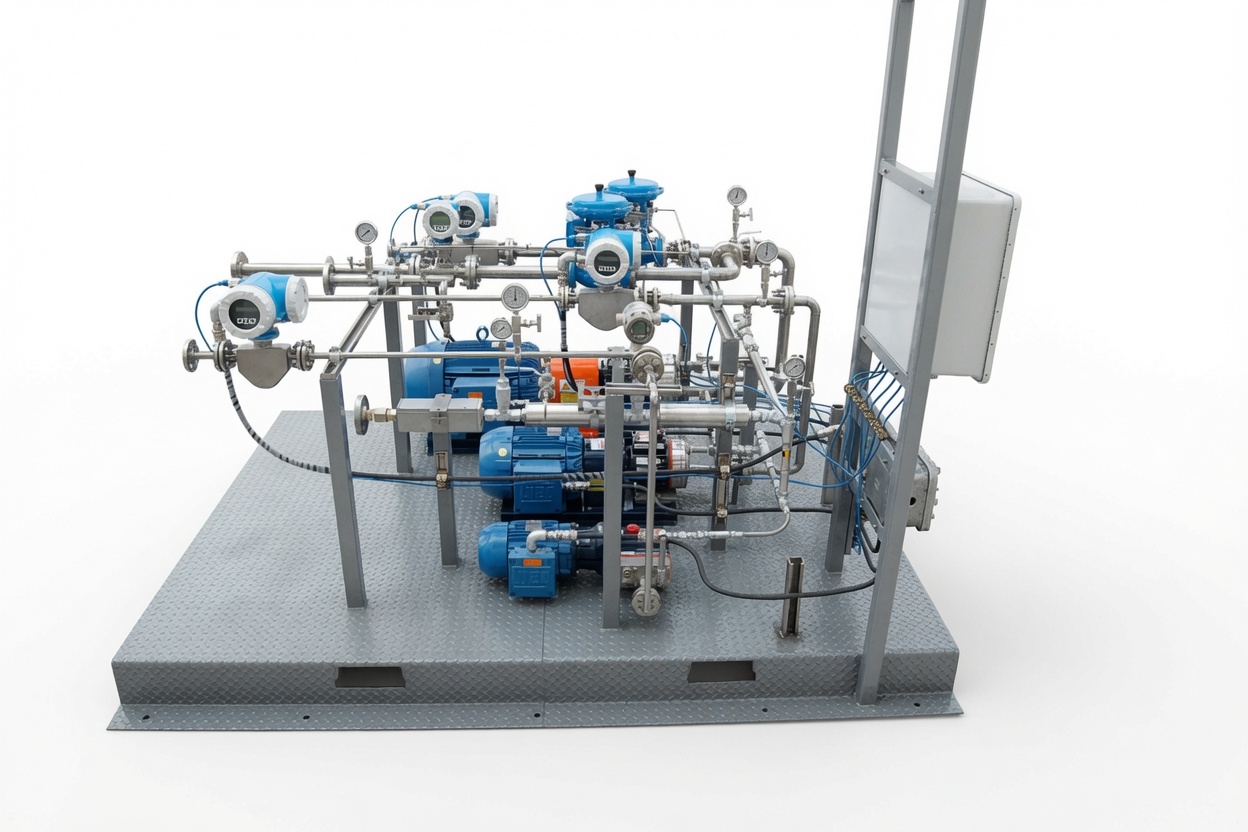
Cavitation Systems

Cavitation

The Power of Controlled Bubble Collapse

Cavitation is a physical phenomenon that occurs when the pressure in a liquid drops below its vapor pressure, causing the rapid formation, growth, and violent collapse of vapor-filled microbubbles.

During collapse, these bubbles release extreme localized energy — generating shock waves, microjets (up to 1000 m/s), temperatures up to 5000 K, and pressures up to 1000 atm — all within microseconds.

This powerful energy release is harnessed in modern industry for:

  • Emulsification & Homogenization – creating stable nano-emulsions
  • Extraction – breaking cell walls for higher bioactive yields
  • Chemical Processing – intensifying reactions and mass transfer
  • Water Treatment & Biodiesel – advanced oxidation and green fuel production
Turning destructive bubble collapse into a highly efficient, non-thermal, and sustainable processing tool.

Description

Cavitation Systems

Harnessing the Power of Bubble Dynamics in Modern Engineering & Industry

What is Cavitation?

Cavitation is a fascinating physical phenomenon that occurs when the local pressure in a liquid drop below its vapor pressure, leading to the rapid formation of vapor-filled cavities (bubbles). These bubbles grow and then collapse violently when they encounter higher pressure regions, releasing enormous, localized energy in the form of shock waves, microjets, high temperatures (up to 5000 K), and pressures (up to 1000 atm).

Key Principle: Cavitation bridges fluid dynamics, acoustics, and chemistry — turning destructive potential into powerful, controlled industrial processes.

Types of Cavitation Systems

🔊

Ultrasonic (Acoustic) Cavitation

Generated by high-frequency sound waves (typically 20–100 kHz). Bubbles oscillate and collapse due to pressure fluctuations from ultrasonic fields. Ideal for precise, small-scale applications.

  • Stable & Transient bubbles
  • Excellent for emulsification & cell disruption
🌊

Hydrodynamic Cavitation

Created by velocity changes in flowing liquids (Venturi effect, orifices, rotors). More scalable and energy-efficient for continuous industrial processes.

  • Orifice plates, Venturi reactors, rotor-stator systems
  • High throughput & low operating cost

How Cavitation Systems Operate

  1. 1
    Nucleation: Pressure drops below vapor pressure → microscopic gas/vapor bubbles form.
  2. 2
    Growth: Bubbles expand rapidly in low-pressure zones.
  3. 3
    Collapse: Sudden pressure recovery causes implosion → extreme energy release.

Industrial & Scientific Applications

♻️

Water Treatment & Disinfection

Generates hydroxyl radicals (•OH) for advanced oxidation processes (AOPs). Destroys pollutants, bacteria, and pharmaceuticals in wastewater.

🧪

Chemical Processing

Intensifies reactions through better mixing, emulsification, and mass transfer. Used in biodiesel production, extraction, and nanoparticle synthesis.

🏭

Food & Pharma

Homogenization of milk, juices, and creams. Cell disruption for bioactive compound extraction. Non-thermal pasteurization.

⚕️

Medical Applications

Ultrasonic cavitation for fat reduction (body contouring), lithotripsy (kidney stones), and targeted drug delivery.

✅ Advantages

  • Green technology — minimal chemicals required
  • Energy efficient compared to traditional mixing
  • Scalable from lab to industrial levels
  • Enhanced mass transfer & reaction rates

⚠️ Challenges & Mitigation

  • Uncontrolled cavitation causes erosion in pumps & turbines
  • Noise & vibration management required
  • Optimized reactor design critical for performance

The Future of Cavitation Technology

From preventing damage in hydraulic systems to revolutionizing sustainable manufacturing and environmental remediation, cavitation systems represent a powerful, versatile tool in modern engineering. Ongoing advancements in reactor design and hybrid technologies continue to unlock new possibilities.

Controlled cavitation turns destruction into innovation.

Extraction

Cavitation in Extraction Processes

Accelerating Bioactive Compound Recovery with Intense Shear & Cell Disruption

Ultrasonic & Hydrodynamic Cavitation • Green Extraction Technology

Cavitation-Assisted Extraction

Cavitation enhances extraction by generating powerful mechanical forces that disrupt cell walls, increase mass transfer, and improve solvent penetration into plant, algal, or microbial matrices. The collapse of microbubbles produces microjets, shock waves, and localized turbulence that release intracellular compounds (polyphenols, essential oils, proteins, pigments, etc.) far more efficiently than traditional solvent or maceration methods.

Core Benefit: Solvent-free or reduced-solvent “green extraction” with higher yields, shorter times, and preserved bioactivity.

Cavitation vs Traditional Extraction Methods

Parameter Soxhlet / Maceration Supercritical CO₂ Cavitation Systems
Extraction Time 4–48 hours 1–4 hours 5–60 minutes
Yield Improvement Baseline High 20–200% higher
Solvent Usage High Low / None Low or Solvent-Free
Bioactivity Preservation Moderate (heat) Excellent Excellent (non-thermal)
Energy & Cost High Very High Low

Cavitation Systems Used for Extraction

System Type Mechanism Operating Range Best Suited For
Ultrasonic Cavitation Acoustic waves induce bubble oscillation and collapse 20–40 kHz, batch or flow cell Lab & pilot scale, heat-sensitive compounds, essential oils
Hydrodynamic Cavitation Venturi/orifice/rotor-stator pressure drops in continuous flow 2–15 bar, high throughput Industrial scale, large-volume plant material
Hybrid / Assisted Cavitation Cavitation + enzymes, microwaves, or mild solvents Combined parameters Difficult matrices (algae, seeds, roots)

Step-by-Step Cavitation Extraction Mechanism

1 Cell Disruption: Bubble collapse creates microjets and shear forces that rupture plant cell walls.
2 Mass Transfer Enhancement: Turbulence and streaming dramatically increase solvent penetration and compound diffusion.
3 Radical Formation: •OH radicals help break down complex matrices and improve release of bound compounds.
4 Rapid Separation: Finer particle size leads to faster filtration and higher purity extracts.

Key Extraction Applications

Source Material Target Compounds Benefits of Cavitation Typical Yield Gain
Medicinal Plants & Herbs Polyphenols, flavonoids, alkaloids Higher antioxidant activity, shorter time 30–80%
Essential Oils (Citrus, Lavender, etc.) Terpenes, volatiles Solvent-free extraction, better aroma profile 25–60%
Algae & Microalgae Lipids, carotenoids, astaxanthin Cell wall rupture + lipid release in one step 50–150%
Seeds & Nuts Oils, proteins Cold extraction, higher oil recovery 20–50%
Food By-products (Peels, Pomace) Pectin, antioxidants, fibers Valorization of waste, zero-waste approach 40–100%

✅ Major Advantages

  • • Significantly higher extraction yields
  • • Reduced extraction time and solvent use
  • • Preservation of thermolabile compounds
  • • Eco-friendly and cost-effective
  • • Scalable from lab to industrial production

⚠️ Challenges & Solutions

  • • Over-sonication can degrade sensitive molecules — Solution: Optimized amplitude & time
  • • Solid-liquid separation — Solution: Integrated filtration systems
  • • Scale-up consistency — Solution: CFD modeling and continuous flow reactors

Cavitation: The Future of Green Extraction

Cavitation-assisted extraction is transforming how industries recover valuable bioactive compounds from natural sources. It delivers higher efficiency, superior quality, and environmental sustainability — making it the preferred technology for modern nutraceutical, pharmaceutical, cosmetic, and food ingredient production.

Unlocking nature’s treasures with controlled bubble power.

Emulsification

Cavitation for Emulsification

Advanced Bubble Dynamics Creating Stable, High-Quality Emulsions

Hydrodynamic & Ultrasonic Cavitation • Industrial Applications

Cavitation in Emulsification

Emulsification is the process of dispersing one immiscible liquid into another (e.g., oil in water) to form a stable mixture. Cavitation enhances this dramatically by generating intense shear forces, microjets, and turbulence during bubble collapse. This breaks droplets down to sub-micron or nano sizes with exceptional uniformity and long-term stability — far superior to conventional high-shear mixers.

Why Cavitation Wins: It delivers energy precisely at the interface, reducing droplet size while minimizing energy consumption and heat generation.

Cavitation vs Traditional Emulsification Methods

Parameter High-Shear Mixer High-Pressure Homogenizer Cavitation Systems
Droplet Size 1–10 µm 0.2–2 µm 0.05–0.5 µm (nano)
Energy Efficiency Low Medium High (30–70% savings)
Stability Moderate Good Excellent (months–years)
Heat Generation High Very High Low (non-thermal)
Scalability Good Limited Excellent (continuous flow)

Cavitation Systems Used in Emulsification

Type Mechanism Typical Frequency / Pressure Best For
Ultrasonic Cavitation High-frequency sound waves create oscillating bubbles 20–100 kHz Lab-scale, nano-emulsions, pharmaceuticals, cosmetics
Hydrodynamic Cavitation Pressure drop across Venturi, orifice, or rotor-stator 1–10 bar differential Industrial continuous production, food, fuel emulsions
Hybrid Systems Ultrasonic + Hydrodynamic or with microfluidics Variable High-value products requiring extreme stability

Step-by-Step: Cavitation-Driven Emulsification

1 Bubble Formation: Local pressure drops below vapor pressure in the cavitation zone.
2 Violent Collapse: Shock waves, microjets (up to 1000 m/s), and extreme turbulence shear droplets.
3 Droplet Breakup & Stabilization: Surfactants quickly coat new interfaces, preventing coalescence.

Key Industrial Applications

Industry Emulsion Type Benefits of Cavitation Typical Droplet Size
Food & Beverage Milk, salad dressings, mayonnaise, flavor emulsions Non-thermal pasteurization + homogenization in one step 0.1–0.8 µm
Cosmetics & Pharma Creams, lotions, drug delivery nanoemulsions Higher bioavailability and shelf-life 50–300 nm
Fuel & Lubricants Diesel-water emulsions, biodiesel blends Improved combustion efficiency & reduced emissions 0.2–1 µm
Paints & Coatings Pigment dispersions, latex emulsions Uniform particle distribution & faster processing 0.1–0.5 µm

✅ Major Advantages

  • • Nano-scale droplets with narrow size distribution
  • • Lower surfactant requirement (cost & cleaner label)
  • • Continuous processing capability
  • • Reduced energy use and processing time

⚠️ Challenges & Solutions

  • • Over-processing can cause coalescence — Solution: Optimized residence time
  • • Equipment erosion — Solution: Use hardened materials (stainless, titanium)
  • • Scale-up parameters — Solution: CFD modeling + pilot testing

Cavitation: The Future of Emulsification

Cavitation-based emulsification delivers superior quality, efficiency, and sustainability across industries. As reactor designs improve, this technology is becoming the gold standard for producing stable nanoemulsions at scale.

Transforming immiscible liquids into perfectly stable, high-performance emulsions — one controlled bubble collapse at a time.

Homogenization

Cavitation for Homogenization

Powerful Bubble Collapse for Uniform Particle Size Reduction & Stable Products

Hydrodynamic & Ultrasonic Cavitation • Industrial Homogenization

Cavitation in Homogenization

Homogenization is the process of reducing the size of particles, droplets, or fat globules in a liquid to create a uniform, stable product. Cavitation achieves this through intense mechanical forces generated during bubble formation and violent collapse — producing microjets, shock waves, and extreme turbulence that break particles down to sub-micron levels with high efficiency.

Why Cavitation Excels: It combines particle size reduction, emulsification, and mixing in a single energy-efficient step, often replacing or enhancing traditional high-pressure homogenizers.

Cavitation vs Traditional Homogenization Methods

Parameter High-Pressure Valve Homogenizer Colloid Mill Cavitation Systems
Particle/Droplet Size 0.2–2 µm 1–5 µm 0.05–0.8 µm (nano)
Energy Efficiency Medium Low High (40–75% savings)
Product Stability Good Moderate Excellent
Temperature Rise High Moderate Minimal
Maintenance & Scalability High wear on valves Good Low wear, excellent continuous flow

Cavitation Systems for Homogenization

Type Working Principle Operating Range Primary Applications
Hydrodynamic Cavitation Venturi, orifice plates, or rotor-stator devices create pressure drops 1–20 bar, high flow rates Dairy, beverages, continuous industrial lines
Ultrasonic Cavitation High-frequency acoustic waves induce bubble oscillation & collapse 20–40 kHz, probe or flow-cell Pharma, nano-suspensions, lab-to-pilot scale
Hybrid Cavitation Combination of hydrodynamic + ultrasonic or with high pressure Multi-parameter control High-value products, advanced drug delivery

Step-by-Step Cavitation Homogenization Process

1 Pressure Drop & Nucleation: Liquid passes through a constriction creating low-pressure zones where vapor bubbles form.
2 Bubble Collapse: Rapid pressure recovery causes implosion, generating localized shear forces >10^6 s⁻¹ and microjets.
3 Particle/Droplet Disruption: Fat globules, cells, or solid particles are shattered into uniform nano/micro sizes.
4 Stabilization: Uniform distribution prevents creaming or sedimentation.

Major Industrial Applications

Industry Product Examples Key Benefits Achieved Particle Size
Dairy Processing Milk, cream, yogurt, ice cream mix Prevents cream separation, smoother texture, longer shelf life 0.2–0.8 µm
Beverages & Juices Fruit juices, plant-based milks, soft drinks Improved mouthfeel, stable pulp suspension, better flavor release 0.1–1 µm
Pharmaceuticals Nano-suspensions, emulsions, injectables Higher bioavailability, uniform dosing 50–500 nm
Chemical & Coatings Paints, inks, polymer dispersions Finer pigment dispersion, better stability 0.1–0.6 µm
Biotechnology Cell disruption for intracellular products Gentle yet effective extraction of proteins & enzymes Cell debris < 1 µm

✅ Key Advantages

  • • Superior particle size uniformity
  • • Reduced energy consumption
  • • Lower heat input (preserves heat-sensitive ingredients)
  • • Continuous processing with easy scale-up
  • • Fewer passes required compared to traditional methods

⚠️ Challenges & Solutions

  • • Potential equipment erosion — Solution: Advanced materials (ceramic, titanium)
  • • Optimization of flow parameters — Solution: CFD simulation & sensors
  • • Initial capital investment — Solution: High ROI through efficiency gains

Cavitation: Next-Generation Homogenization

Cavitation-based homogenization is transforming industries by delivering finer, more stable products with lower energy use and minimal thermal degradation. From dairy to pharmaceuticals, this technology sets new standards for quality and efficiency.

Controlled cavitation — turning pressure drops into perfectly homogenized solutions.

Food

Cavitation in Food Processing

Revolutionizing Food Production with Non-Thermal, Energy-Efficient Technology

Ultrasonic & Hydrodynamic Cavitation • Sustainable Food Applications

Cavitation Technology in the Food Industry

Cavitation is rapidly becoming a game-changing tool in modern food processing. The violent collapse of microbubbles generates intense localized shear forces, turbulence, microjets, and free radicals — all without significantly raising the bulk temperature. This enables non-thermal processing that preserves flavor, nutrients, and color while achieving superior homogenization, extraction, and microbial inactivation.

Key Advantage for Food: Combines multiple unit operations (homogenization, pasteurization, extraction) in one green, energy-efficient step.

Cavitation vs Conventional Food Processing Methods

Parameter Thermal Pasteurization High-Pressure Homogenizer Cavitation Systems
Temperature Impact High (60–120°C) Moderate–High Minimal (Non-thermal)
Nutrient Retention Moderate Good Excellent
Energy Consumption High High Low (40–70% savings)
Shelf Life Extension Good Good Superior
Processing Time Long Medium Very Fast (Continuous)

Cavitation Systems Used in Food Processing

System Type Mechanism Frequency / Pressure Food Applications
Ultrasonic Cavitation High-frequency acoustic waves create oscillating bubbles 20–40 kHz Extraction, emulsification, microbial inactivation
Hydrodynamic Cavitation Venturi or orifice-induced pressure drops in flowing liquids 2–15 bar Continuous homogenization, juice processing, dairy
Rotational/High-Shear Cavitation Rotor-stator devices generating cavitation zones Variable RPM Viscous products, sauces, purees

How Cavitation Works in Food Processing

1 Bubble Generation: Pressure drops below vapor pressure in the processing zone.
2 Violent Collapse: Shock waves, microjets, and radicals disrupt cells, droplets, and microbes.
3 Mass Transfer Enhancement: Improved extraction of bioactive compounds and uniform mixing.
4 Stabilization & Preservation: Finer particles and microbial reduction without heat damage.

Key Applications in Food Industry

Food Category Specific Uses Benefits Typical Results
Dairy Milk homogenization, yogurt texture improvement, cheese whey processing Prevents creaming, smoother mouthfeel, higher yield Fat globules < 0.8 µm
Beverages & Juices Orange/lemon juice, plant-based milks, smoothies Pulp stabilization, enhanced flavor & nutrient extraction Particle size 0.1–1 µm
Oils & Emulsions Mayonnaise, salad dressings, flavor emulsions Nano-emulsions with longer stability and less stabilizer Droplet size 50–500 nm
Extraction Bioactive compounds from fruits, herbs, algae, seeds Higher yield, shorter time, solvent-free or reduced solvent 20–50% yield increase
Microbial Control Non-thermal pasteurization of juices, milk, sauces Inactivates bacteria, yeasts, molds while preserving freshness 5–7 log reduction

✅ Advantages in Food Processing

  • • Retains heat-sensitive vitamins, antioxidants & flavors
  • • Reduces or eliminates chemical additives
  • • Energy-efficient & environmentally friendly
  • • Continuous processing for high throughput
  • • Improved product texture and shelf life

⚠️ Challenges & Solutions

  • • Scale-up for viscous products — Solution: Optimized reactor geometry
  • • Equipment hygiene & cleaning — Solution: CIP-compatible designs
  • • Regulatory approval — Solution: Extensive validation studies

The Future of Food Processing

Cavitation technology is enabling cleaner, greener, and higher-quality food production. By preserving natural attributes while improving efficiency and safety, it is becoming an essential tool for sustainable food innovation.

From farm to table — cavitation delivers fresher, healthier, and more sustainable food.

Petroleum

Cavitation in Petroleum Industry

Advanced Bubble Dynamics for Enhanced Oil Recovery, Upgrading & Processing

Hydrodynamic Cavitation • Heavy Oil Upgrading • Desulfurization

Cavitation Technology in Petroleum Applications

In the petroleum sector, cavitation is applied to overcome challenges like high viscosity of heavy crude, emulsion stability, sulfur content, and low recovery rates. The extreme conditions created during bubble collapse (high shear, localized high temperature/pressure, and radical formation) enable viscosity reduction, emulsification/demulsification, desulfurization, and improved flow properties without excessive heat or chemicals.

Why Cavitation for Petroleum: It offers a cost-effective, environmentally friendlier alternative to traditional thermal and catalytic methods for heavy oil processing and enhanced oil recovery (EOR).

Cavitation vs Traditional Petroleum Methods

Parameter Thermal Cracking Catalytic Hydrocracking Cavitation Systems
Energy Consumption Very High High Moderate (30–60% lower)
Viscosity Reduction Good Excellent Excellent (up to 90%)
Sulfur Removal Moderate High Significant (oxidative)
Capital & Operating Cost High Very High Lower
Environmental Impact High CO₂ & emissions Moderate Lower (greener)

Cavitation Systems in Petroleum

System Type Mechanism Operating Conditions Petroleum Applications
Hydrodynamic Cavitation Venturi, orifice, or rotor-stator induced pressure drops 5–50 bar, high flow Heavy oil upgrading, viscosity reduction, EOR
Ultrasonic Cavitation Acoustic waves generating bubble collapse 20–40 kHz Desulfurization, demulsification, pipeline cleaning
Hybrid Cavitation Cavitation + oxidants, catalysts or hydrogen Combined parameters Deep desulfurization, nano-emulsion fuels

How Cavitation Works in Petroleum Processing

1 Bubble Formation: Rapid pressure drop in flowing crude or emulsion creates vapor cavities.
2 Implosive Collapse: Generates microjets (>500 m/s), shock waves, and •OH radicals.
3 Molecular Cracking & Reactions: Breaks C-S bonds, asphaltenes, and long-chain hydrocarbons.
4 Emulsion Breaking / Formation: Destabilizes water-in-oil emulsions or creates stable oil-in-water for transport.

Key Applications in Petroleum Industry

Application Area Process Benefits Typical Outcomes
Enhanced Oil Recovery (EOR) Cavitation-assisted injection in reservoirs Reduces oil viscosity, improves mobility ratio 10–30% additional recovery
Heavy Oil Upgrading Viscosity reduction & asphaltene cracking Converts heavy fractions to lighter products Viscosity drop up to 90%
Desulfurization Oxidative desulfurization using cavitation + oxidants Removes refractory sulfur compounds 50–80% sulfur reduction
Demulsification Breaking water-in-oil emulsions Faster phase separation, cleaner oil >95% water removal
Fuel Emulsification Water-in-diesel or heavy fuel emulsions Better combustion, reduced emissions Stable nano-emulsions

✅ Advantages in Petroleum

  • • Significant viscosity reduction without high heat
  • • Lower energy and chemical usage
  • • Improved flow assurance in pipelines
  • • Potential for on-site upgrading
  • • Reduced environmental footprint

⚠️ Challenges & Solutions

  • • Erosion of reactor components — Solution: Hardened alloys & coatings
  • • Handling high-viscosity feeds — Solution: Pre-heating or dilution
  • • Scale-up & integration — Solution: Pilot testing + process simulation

Cavitation: A Sustainable Solution for Petroleum

From enhancing oil recovery to upgrading heavy crudes and reducing emissions, cavitation technology is emerging as a powerful, cost-effective tool in the petroleum industry. It supports the transition toward more efficient and environmentally responsible operations.

Harnessing bubble power to unlock more value from every barrel.

Biodiesel

Cavitation in Biodiesel Production

Intensifying Transesterification for Higher Yields, Faster Reactions & Greener Fuel

Ultrasonic & Hydrodynamic Cavitation • Sustainable Biodiesel

Cavitation Technology for Biodiesel

Biodiesel is produced via transesterification of vegetable oils, animal fats, or waste oils with methanol or ethanol in the presence of a catalyst. Conventional methods suffer from poor mass transfer due to immiscible phases. Cavitation dramatically improves this by generating intense micro-mixing, localized high temperature and pressure, and free radicals that accelerate the reaction, resulting in higher biodiesel yields in much shorter times with lower catalyst and energy requirements.

Why Cavitation Excels: It overcomes mass transfer limitations, enabling near-complete conversion in minutes instead of hours while supporting waste oil feedstocks.

Cavitation vs Conventional Biodiesel Production

Parameter Mechanical Stirring High-Pressure Reactor Cavitation Systems
Reaction Time 1–4 hours 30–90 min 5–30 minutes
Biodiesel Yield 85–92% 92–96% 96–99+%
Catalyst Usage 1–2 wt% 0.8–1.5 wt% 0.3–0.8 wt%
Energy Consumption High High 40–70% lower
Methanol-to-Oil Ratio 6:1 – 12:1 6:1 4:1 – 6:1

Cavitation Systems for Biodiesel Production

System Type Mechanism Operating Parameters Advantages for Biodiesel
Ultrasonic Cavitation High-frequency sound waves create oscillating & collapsing bubbles 20–40 kHz, probe or flow cell Excellent emulsification, lab-to-pilot scale, high purity
Hydrodynamic Cavitation Pressure drop across Venturi, orifice, or rotor-stator 2–10 bar, continuous flow Industrial scale, energy efficient, handles waste oils
Hybrid Cavitation Ultrasonic + Hydrodynamic or with microwave Multi-energy input Maximum yield, fastest reaction for low-quality feedstocks

Step-by-Step Cavitation-Assisted Transesterification

1 Emulsification: Cavitation creates fine micro-droplets of oil and methanol, vastly increasing interfacial area.
2 Radical & Hot-Spot Formation: Bubble collapse generates •OH radicals and localized hotspots (up to 5000 K, 1000 atm).
3 Accelerated Reaction: Enhanced mass transfer drives rapid conversion of triglycerides to fatty acid methyl esters (FAME).
4 Phase Separation: High-purity biodiesel and glycerol separate quickly due to uniform reaction.

Benefits & Feedstock Applications

Feedstock Cavitation Benefits Yield Improvement Reaction Time
Virgin Vegetable Oils Faster conversion, lower methanol ratio 97–99% 10–20 min
Waste Cooking Oil (WCO) Handles high FFA content, reduces soap formation 94–98% 15–30 min
Animal Fats & Algae Oil Better emulsification of viscous feeds 95–98% 20–40 min
Microalgae Biodiesel Cell disruption + transesterification in one step Up to 99% 5–15 min

✅ Major Advantages

  • • Dramatically shorter reaction times
  • • Higher conversion yields
  • • Reduced excess methanol and catalyst
  • • Works well with low-quality & high-FFA feedstocks
  • • Lower energy use and greener process

⚠️ Challenges & Solutions

  • • Equipment erosion at high throughput — Solution: Use stainless steel or titanium reactors
  • • Temperature control — Solution: Flow-through cooling systems
  • • Scale-up optimization — Solution: CFD modeling and pilot plants

Cavitation: The Future of Biodiesel Production

Cavitation-assisted biodiesel production delivers higher efficiency, better economics, and greater sustainability. It is particularly powerful for processing low-cost waste oils, making biodiesel more competitive with fossil diesel while reducing environmental impact.

Turning waste oils and bubbles into clean, renewable energy — one cavitation collapse at a time.

Reviews

There are no reviews yet.


Be the first to review “Cavitation Systems”

Your email address will not be published. Required fields are marked *

2 + eleven =

Translate »
content-1701

yakinjp

yakinjp

rtp yakinjp

yakinjp

yakinjp

yakin jp

yakinjp id

maujp

maujp

maujp

\

sabung ayam online

sabung ayam online

SLOT MAHJONG

sabung ayam online

artikel 000000121

artikel 000000122

artikel 000000123

artikel 000000124

artikel 000000125

artikel 000000126

artikel 000000127

artikel 000000128

artikel 000000129

artikel 000000130

artikel 000000131

artikel 000000132

artikel 000000133

artikel 000000134

artikel 000000135

artikel 000000136

artikel 000000137

artikel 000000138

artikel 000000139

artikel 000000140

artikel 000000141

artikel 000000142

artikel 000000143

artikel 000000144

artikel 000000145

artikel 000000146

artikel 000000147

artikel 000000148

artikel 000000149

artikel 000000150

article 0000091

article 0000092

article 0000093

article 0000094

article 0000095

article 0000096

article 0000097

article 0000098

article 0000099

article 0000100

article 0000101

article 0000102

article 0000103

article 0000104

article 0000105

article 0000106

article 0000107

article 0000108

article 0000109

article 0000110

article 0000111

article 0000112

article 0000113

article 0000114

article 0000115

article 0000116

article 0000117

article 0000118

article 0000119

article 0000120

artikel 0000106

artikel 0000107

artikel 0000108

artikel 0000109

artikel 0000110

artikel 0000111

artikel 0000112

artikel 0000113

artikel 0000114

artikel 0000115

artikel 0000116

artikel 0000117

artikel 0000118

artikel 0000119

artikel 0000120

artikel 0000121

artikel 0000122

artikel 0000123

artikel 0000124

artikel 0000125

artikel 0000126

artikel 0000127

artikel 0000128

artikel 0000129

artikel 0000130

artikel 0000131

artikel 0000132

artikel 0000133

artikel 0000134

artikel 0000135

pengadilan 000086

pengadilan 000087

pengadilan 000088

pengadilan 000089

pengadilan 000090

pengadilan 000091

pengadilan 000092

pengadilan 000093

pengadilan 000094

pengadilan 000095

pengadilan 000096

pengadilan 000097

pengadilan 000098

pengadilan 000099

pengadilan 000100

pengadilan 000101

pengadilan 000102

pengadilan 000103

pengadilan 000104

pengadilan 000105

article 3000061

article 3000062

article 3000063

article 3000064

article 3000065

article 3000066

article 3000067

article 3000068

article 3000069

article 3000070

article 3000071

article 3000072

article 3000073

article 3000074

article 3000075

article 3000076

article 3000077

article 3000078

article 3000079

article 3000080

article 3000081

article 3000082

article 3000083

article 3000084

article 3000085

article 3000086

article 3000087

article 3000088

article 3000089

article 3000090

article 3000091

article 3000092

article 3000093

article 3000094

article 3000095

article 3000096

article 3000097

article 3000098

article 3000099

article 3000100

article 3000101

article 3000102

article 3000103

article 3000104

article 3000105

article 3000106

article 3000107

article 3000108

article 3000109

article 3000110

article 3000111

article 3000112

article 3000113

article 3000114

article 3000115

article 3000116

article 3000117

article 3000118

article 3000119

article 3000120

article 2000081

article 2000082

article 2000083

article 2000084

article 2000085

article 2000086

article 2000087

article 2000088

article 2000089

article 2000090

article 2000091

article 2000092

article 2000093

article 2000094

article 2000095

article 2000096

article 2000097

article 2000098

article 2000099

article 2000100

article 2000101

article 2000102

article 2000103

article 2000104

article 2000105

article 2000106

article 2000107

article 2000108

article 2000109

article 2000110

invoice 00055

invoice 00056

invoice 00057

invoice 00058

invoice 00059

invoice 00060

invoice 00061

invoice 00062

invoice 00063

invoice 00064

invoice 00065

invoice 00066

invoice 00067

invoice 00068

invoice 00069

invoice 00070

invoice 00071

invoice 00072

invoice 00073

invoice 00074

invoice 00075

invoice 00076

invoice 00077

invoice 00078

invoice 00079

invoice 00080

invoice 00081

invoice 00082

invoice 00083

invoice 00084

invoice 00085

invoice 00086

article 238000401

article 238000402

article 238000403

article 238000404

article 238000405

article 238000406

article 238000407

article 238000408

article 238000409

article 238000410

article 238000411

article 238000412

article 238000413

article 238000414

article 238000415

article 238000416

article 238000417

article 238000418

article 238000419

article 238000420

article 238000421

article 238000422

article 238000423

article 238000424

article 238000425

article 238000426

article 238000427

article 238000428

article 238000429

article 238000430

article 238000431

article 238000432

article 238000433

article 238000434

article 238000435

article 238000436

article 238000437

article 238000438

article 238000439

article 238000440

article 238000441

article 238000442

article 238000443

article 238000444

article 238000445

article 238000446

article 238000447

article 238000448

article 238000449

article 238000450

article 238000451

article 238000452

article 238000453

article 238000454

article 238000455

article 238000456

article 238000457

article 238000458

article 238000459

article 238000460

artikel 0000136

artikel 0000137

artikel 0000138

artikel 0000139

artikel 0000140

artikel 0000141

artikel 0000142

artikel 0000143

artikel 0000144

artikel 0000145

content-1701